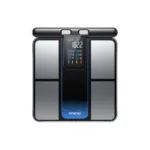
At the heart of modern physiotherapy and rehabilitation is objective, measurable, and repeatable assessment. The assessment "feels stronger already" is no longer enough to motivate a patient or to prepare an evidence-based report for a doctor, insurance, or referring specialist. Kinvent (Montpellier, France) has developed a complete ecosystem of wireless sensors that makes measuring strength, balance, and joint mobility fast, accurate, and feasible in everyday work – right in your clinic, without lab equipment or wires.
medpoint (Inpello OÜ) mediates and supports Kinvent solutions in Estonia: we help you choose the right devices and software package, configure the system and provide support after the purchase. This introduction provides an overview of the Kinvent ecosystem, individual sensors, software levels and how they fit into your center's daily work.
Why objective measurement?
Objective numbers change both the quality of your work and the patient experience. The Kinvent system helps you:
Replace subjective assessment with an exact number. Maximal and isometric strength, joint range of motion, balance, and weight distribution gain specific, repeatable values.
Identify gaps and asymmetries. The strength or mobility of the injured side can be immediately compared to the healthy side and the percentage of deficit (LSI) can be calculated.
Motivate the patient. Real-time biofeedback and visible progress over time keep the patient engaged and reduce interruptions.
Make evidence-based decisions. Clear criteria for increasing load, selecting exercises, and returning to sport (return-to-sport).
Document and share. Ready-made reports that can be given to the patient, added to medical software, or shared with the treatment team and other centers.
One app, ten sensors
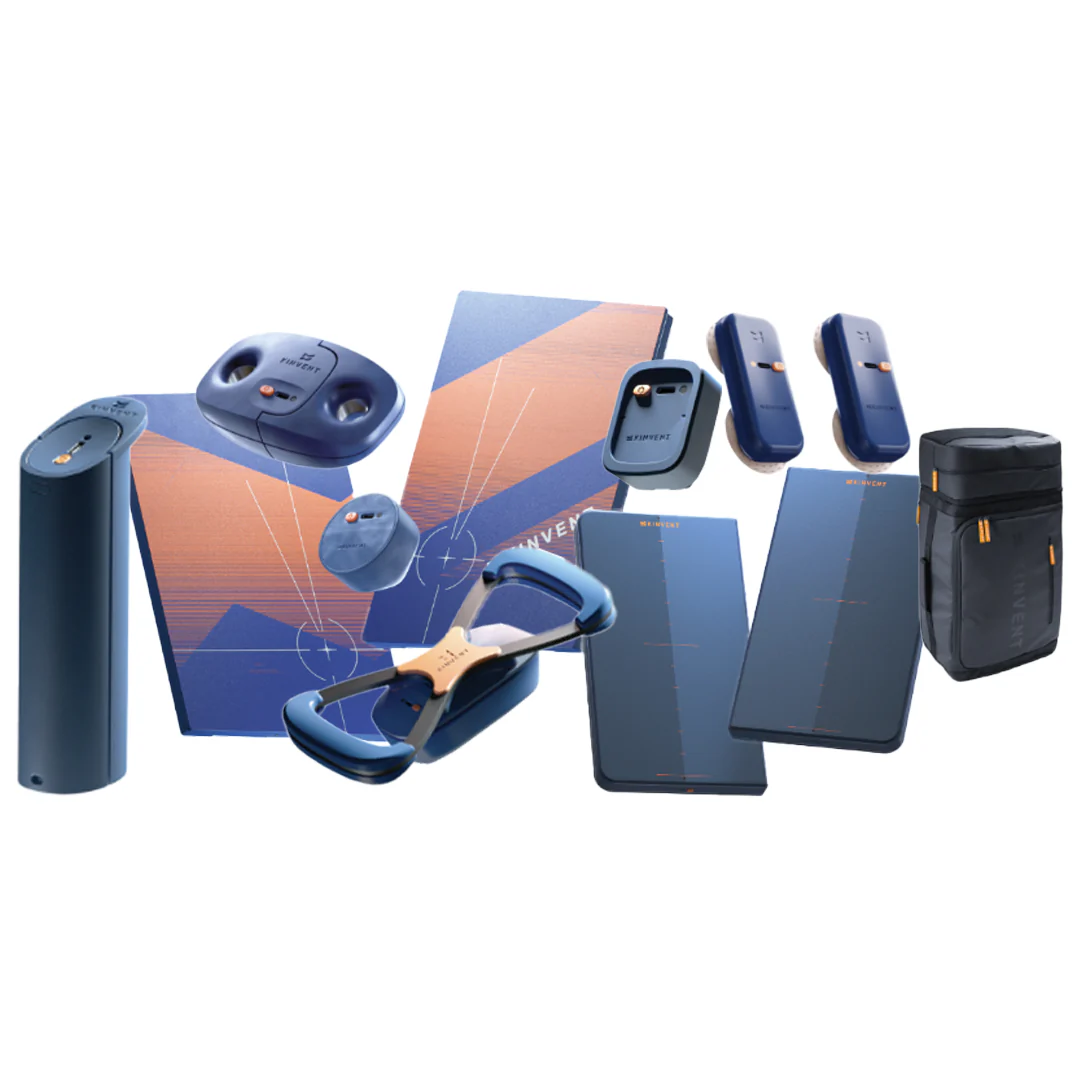
The heart of the whole system is Kinvent Physio app. All Kinvent sensors (ten different types in total) connect to the app wirelessly via Bluetooth and transmit measurement results in real time. One sensor or a whole set - the workflow and reports remain the same. The app also works offline, so weak signal or lack of WiFi are not a problem when measuring.
This means that you are not buying a single device, but growing ecosystem: you can start with a couple of sensors and expand if necessary – everything works under the same app and the same patient database.
Kinvent Physio app in more detail
The app is not just a display - it is a complete solution for assessment, biofeedback and reporting:
Over 100 ready-made protocols for common tests (strength, balance, jump, ROM, etc.) and the ability to create your own custom protocols – starting from the basic level.
Real-time biofeedback and playful exercises that keep the patient engaged and allow them to train towards a specific goal.
Normative data and percentile comparisons, including the ability to enter, edit, and apply your own regulatory data.
Cassandra AI – built-in artificial intelligence that writes automatic, understandable comments on measurement results and can recommend appropriate assessment protocols. The workflow is simple: you take a measurement, open the report, click “AI” in the comments section, and Kassandra creates the content.
Ready PDF report with the clinic's logo and signature, which can be immediately given to the patient or included in the documentation.
CSV export with a full set of KPIs for raw data and further analysis (in a higher-level license).
Smart Mode with video recording and isometric test auto-detection, and Group Testing for multi-patient or multi-athlete workflow.
Sharing between multiple centers – Patient data and programs from the same organization are available in different offices.
Sensors
Below is an overview of the most commonly used sensors in clinical work. They all work with the same Kinvent Physio app and can be freely combined.
K-Push – pressure dynamometer
Lightweight and fast hand dynamometer for measuring maximal and isometric force in nearly 40 muscle groups. The body or limb presses against the sensor's cushioned pad; the sensor has a strong magnet on the back that attaches directly to a metal surface (squat rack, barbell wall). Measures peak force, average force, and rate of force development (RFD), among other things, and calculates the percentage of deficit on the injured side compared to the healthy side. Ideal for quick "on the go" assessments.
K-Pull – pull dynamometer
Measures tensile force and is attached between the limb and a stationary attachment point (treatment table, squat rack, barbell wall). The kit includes straps and loop attachments, making it K-Bull suitable for fixation anywhere. For strong muscle groups (e.g. hip abduction), the fixed method gives a more reliable result than the therapist's manual resistance, because the hand would be under the force. K-Push and K-Pull complement each other well.
K-Move – smart goniometer
Combined goniometer for objective measurement of joint range of motion (ROM) and quality of movement. Uses an inertial measurement unit (IMU) and achieves accuracy better than 0,5° with minimal drift. Compares injured and healthy limb mobility and refines tests such as single leg standing or squat analysis with K-Push and K-Pull.
K-Power – hybrid motion and performance sensor
A hybrid sensor that combines IMU and UWB technology to track movement speed, power, and dynamic performance. Suitable for advanced functional assessment and speed-based training, and to support return-to-sport decisions where it is important to track movement speed and power, not just static force.
K-Force Plates V3 – portable strength platforms
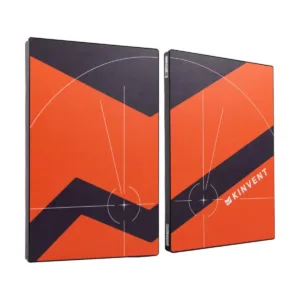
The “workhorse” of clinical work for balance and load assessment. Measures static and dynamic balance, center of pressure (CoP), weight distribution, symmetry, Romberg ratio and range of motion (safety ellipse). Data for each plate is stored separately, allowing calculation of the Limb Symmetry Index (LSI). Accuracy ~0,1%, load capacity up to 600 kg per plate, weight ~2 kg per plate, battery life up to ~20 hours. Suitable for balance and single leg tests, posture and proprioception assessment, fall risk and sit-to-stand tests, and isometric maximal strength (e.g. IMTP) and functional strength.
K-Deltas (3D Deltas) – three-axis force platforms
Dual force platforms that measure force in three axes (X, Y, Z). Adds jump tests (CMJ, SJ, DJ), higher dynamic loads, force-velocity profiles, and advanced postural analysis to the K-Force Plates. Designed for more athletic and advanced use and biomechanical research.
K-MYO – non-invasive EMG sensor
Measures real-time muscle activation, timing and coordination (EMG). Helps identify weakened muscle groups and support neuromuscular control during motor rehabilitation. Uses adhesive electrodes.
Sensor Summary
Sensor
What does it measure?
Main clinical use
K-Push
Pressing force (max and isometric)
Strength assessment in ~40 muscle groups, % deficit
K-Bull
Traction force
Fixed strength tests for strong muscle groups
K-Move
Joint range of motion (ROM), accuracy <0,5°
Mobility monitoring, injured vs. healthy limb
K-Power
Movement speed and power
Functional/Dynamic Performance, RTS
K-Force Plates V3
Balance, CoP, weight distribution, symmetry
Balance, posture, proprioception, fall risk
K-Deltas (3D)
3-axis power, jumping
Jump tests, force-velocity profiles (sports)
K-MYO
Muscle activation (EMG)
Neuromuscular control, weak muscles
K-Force Plates V3 vs K-Deltas – which one for clinical use?
Unless you work primarily with athletes, they cover K-Force Plates V3 the vast majority of clinical needs: balance, posture, proprioception, center of pressure, weight distribution, Romberg test, sit-to-stand, and symmetry. in K-Delta additional jump tests (CMJ/SJ/DJ), higher dynamic loads and force-velocity profiles – these are added values primarily aimed at athletic and advanced use. Most clinics therefore start From K-Force Plates and expands later if necessary.
Software license – three levels
Devices are a physical part of the system; their full functionality is based on a Kinvent Physio software license, which is selected based on the number of user seats and the required functions. The license volume is measured in the number of terminals/profiles – this indicates how many devices can be logged in under one subscription at the same time. There is also a free version, but it has limited functionality and does not work with all devices (e.g. K-Deltas).
Property
Starter
Premium
Excellence
Terminals / profiles
3
6
20
Base and custom protocols
✓
✓
✓
Premium protocols
✓
✓
K-Move and K-Deltas activities
✓
✓
Group testing and video recording
✓
Raw data (CSV) export
✓
Especially suitable for
smaller clinic
most clinics
large center / several offices
Please note: K-Move (and K-Deltas) activities require at least Premium level – so if you have K-Move in your package, Starter is not enough. If you also need CSV export (e.g. for AI reports) and more user seats, Excellence is the right choice. We will help you choose the right package based on your specific equipment set and number of therapists.
The practical side
Battery and charging
Dynamometers (K-Push, K-Pull) work up to ~12 hours continuously, force plates up to ~20 hours; full charge ~2 hours with USB-C cable. Sensors automatically go into sleep mode after 10 minutes of inactivity and the app shows the battery level of each connected sensor even before testing. In practice, charging is rarely enough – usually once a week or less.
Durability
The devices are built for clinical and field use. The K-Push pad and cover withstand accidental drops and bumps. The force plates are also very durable, but as precision instruments, they should be handled with care: use on a flat and rigid surface and avoid dragging them against the ground.
Storage and transportation
All sensors, straps and chargers fit compactly in one bag. Medpoint offers a padded equipment bag (like a medical case) with compartments that keeps the devices safe and makes it easy to move the kit from one center to another. We can also make a separate offer for the bag if you wish.
Who is Kinvent suitable for?
Physiotherapy and rehabilitation clinics – daily assessment of strength, mobility and balance and documentation of progress.
Sports medicine and post-injury recovery – monitoring deficit percentage and data-driven return-to-sport decisions.
Neurological rehabilitation and geriatrics – objective measurement of balance, posture and fall risk.
Organizations with multiple offices or centers – a common system, shared data and reports between all offices.
Research and teaching – repeatable, exportable data for research.
How to get started
We will help you think through the entire process: we will choose a set of equipment and a suitable software package together, arrange a demo or online meeting, and set up the system. If you purchase several centers at once, we will keep the package price affordable. Contact us and let's talk about your center's needs.


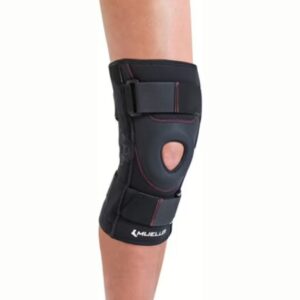 Selection helpWhich orthosis is right for you?Knee, ankle and wrist orthoses with light, medium and strong support – choose the body part and situation.Find the right orthosis →
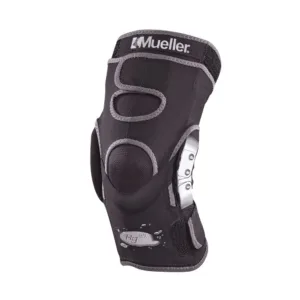 EnimmüüdudMueller® Hinged Knee OrthosisHinged support for the knee after injury and in sports.€64.50View product →